

Who’s Next? The Business of Suing Louisiana
Drive down I-10 through Baton Rouge or I-12 through Hammond and start counting the billboards featuring trial lawyers. You will run out of exits before you run out of smiling faces promising a massive payday.
Louisiana leads the country in legal advertising per capita. That should surprise precisely 0.0% of Louisiana residents. Suing people has become one of the most dependable, if only leeching, industries in the state.
The billboards are just the most visible symptom of a much bigger problem. Louisiana has built an entire political and economic machine around lawsuits.
We have written before about where the money goes. Trial lawyers pour millions of dollars into campaigns for governors, parish presidents, judges, and legislators. They donate to Republicans and Democrats alike because party affiliation is not what matters. What matters is how a politician votes when the next tort reform bill reaches the floor.
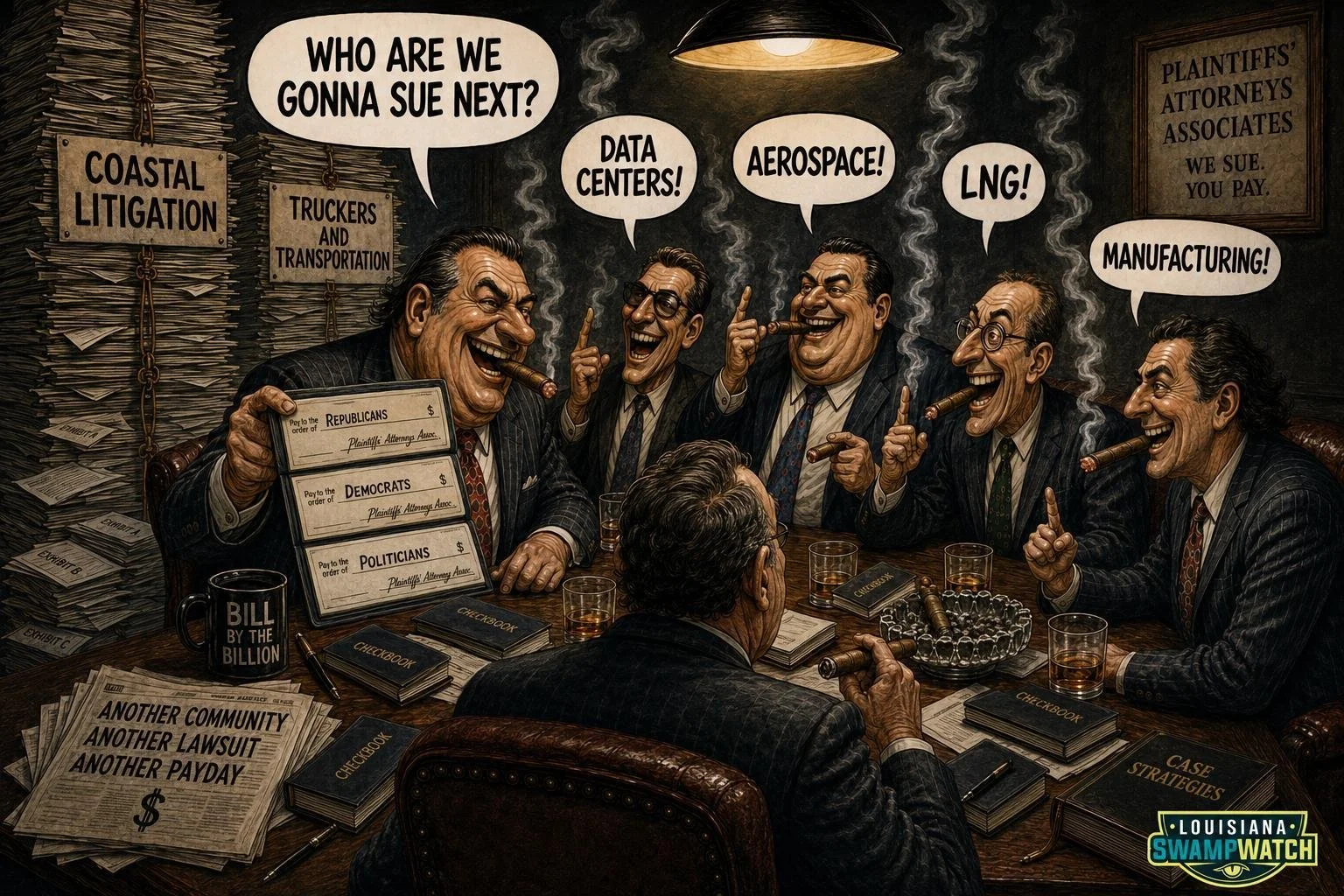
That is the machine, and Louisiana businesses and families have been paying the price for years.
Look at the coastal lawsuits. More than 40 lawsuits have been filed by coastal parishes against over 200 oil and gas companies. Some of those companies are being sued for activities conducted under contracts demanded by the federal government during World War II.
In 2025, a Plaquemines Parish jury handed down a staggering $744 million verdict against Chevron. It took a unanimous U.S. Supreme Court decision just to settle a basic question about where the case belonged. Meanwhile, the lawsuits continue moving through Louisiana courts, one company and one parish at a time, with tens of billions of dollars at stake.
Then there is trucking.
Louisiana remains a regular on the American Tort Reform Foundation’s “Judicial Hellholes” list. Our courts produced $409 million in so-called nuclear verdicts, meaning awards above $10 million, in one year. The next year, that number jumped to $733 million.
The targets included pharmaceutical companies, oil and gas producers, and trucking businesses. But those companies do not simply absorb the costs. The bill gets passed along through higher insurance premiums, higher grocery prices, higher shipping costs, and fewer jobs.
Every Louisiana family pays for the lawsuit industry, whether they ever enter a courtroom or not.
This is not a Republican problem or a Democratic problem. Louisiana’s lawsuit culture has flourished under governors and legislators from both parties. Republicans take the checks. Democrats take the checks. Businesses get sued, trial lawyers get richer, and Louisiana families are told to pay more.
The only thing bipartisan in Baton Rouge may be the plaintiffs’ bar’s campaign contribution list.
The real question is not whether Louisiana has a lawsuit problem. Anyone with eyes can see that. The question is what happens when the current targets have nothing left to give.
Oil and gas has been the main attraction for more than a decade. Trucking is already standing in line. Why would anyone believe the machine stops there?
Louisiana is experiencing one of the largest waves of private investment in a generation. Data centers, LNG export facilities, aerospace companies, and manufacturers are looking at our state. Louisiana finally has something to offer investors besides good food, great music, and long lunches.
But every new company also brings deep pockets, government permits, and a potential defendant for the next creative lawsuit.
If Louisiana allows the same legal model behind the coastal lawsuits and nuclear trucking verdicts to continue, it will not stop with “Big Oil.” It will go wherever the money goes.
Today it may be an energy producer. Tomorrow it could be a data center, a manufacturer, a hospital, a construction company, or any other business successful enough to catch the plaintiffs’ bar’s attention.
That is not paranoia. It is the business model.
Who is next?
Ask the trial lawyers. They are probably already deciding.